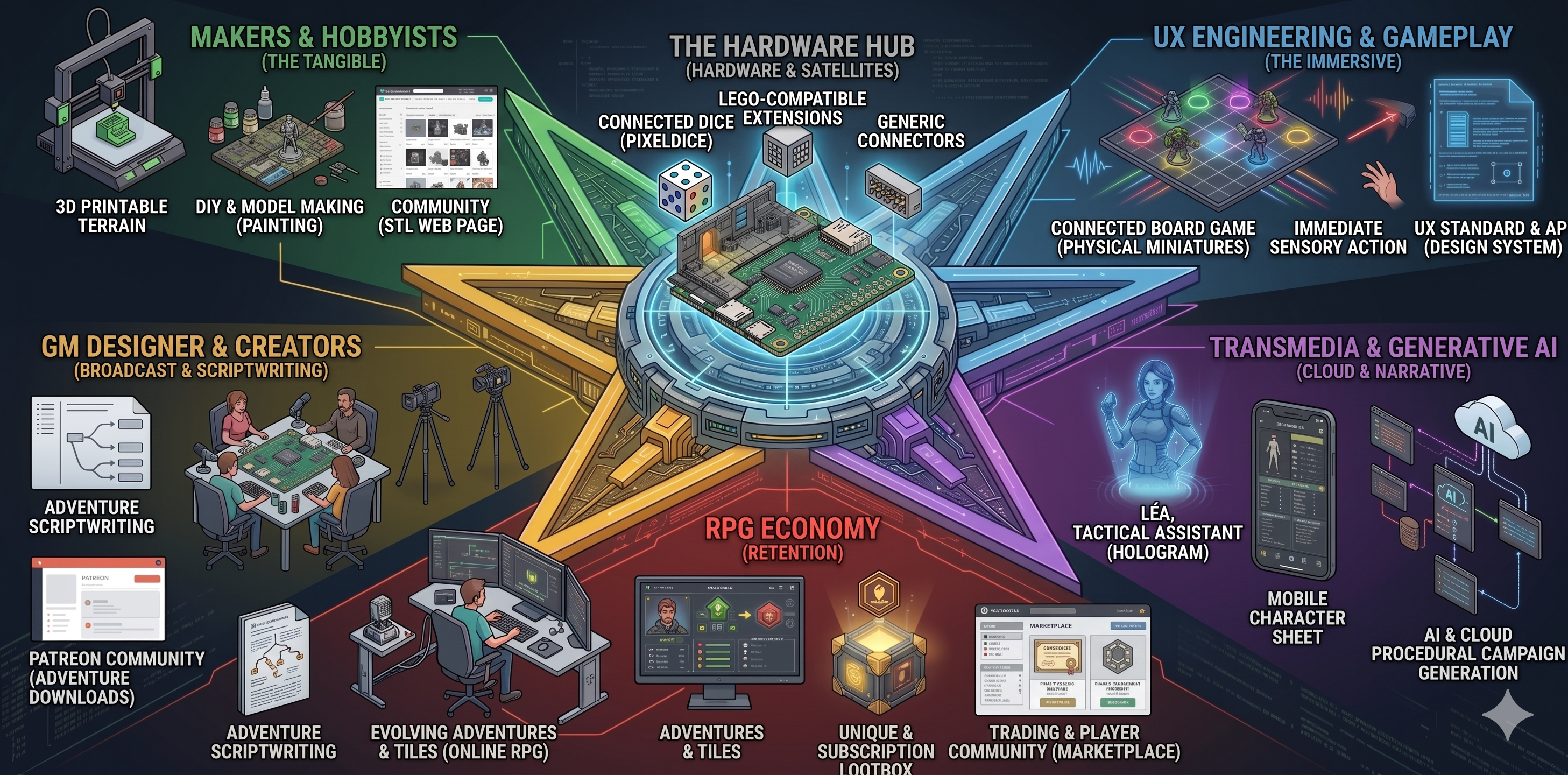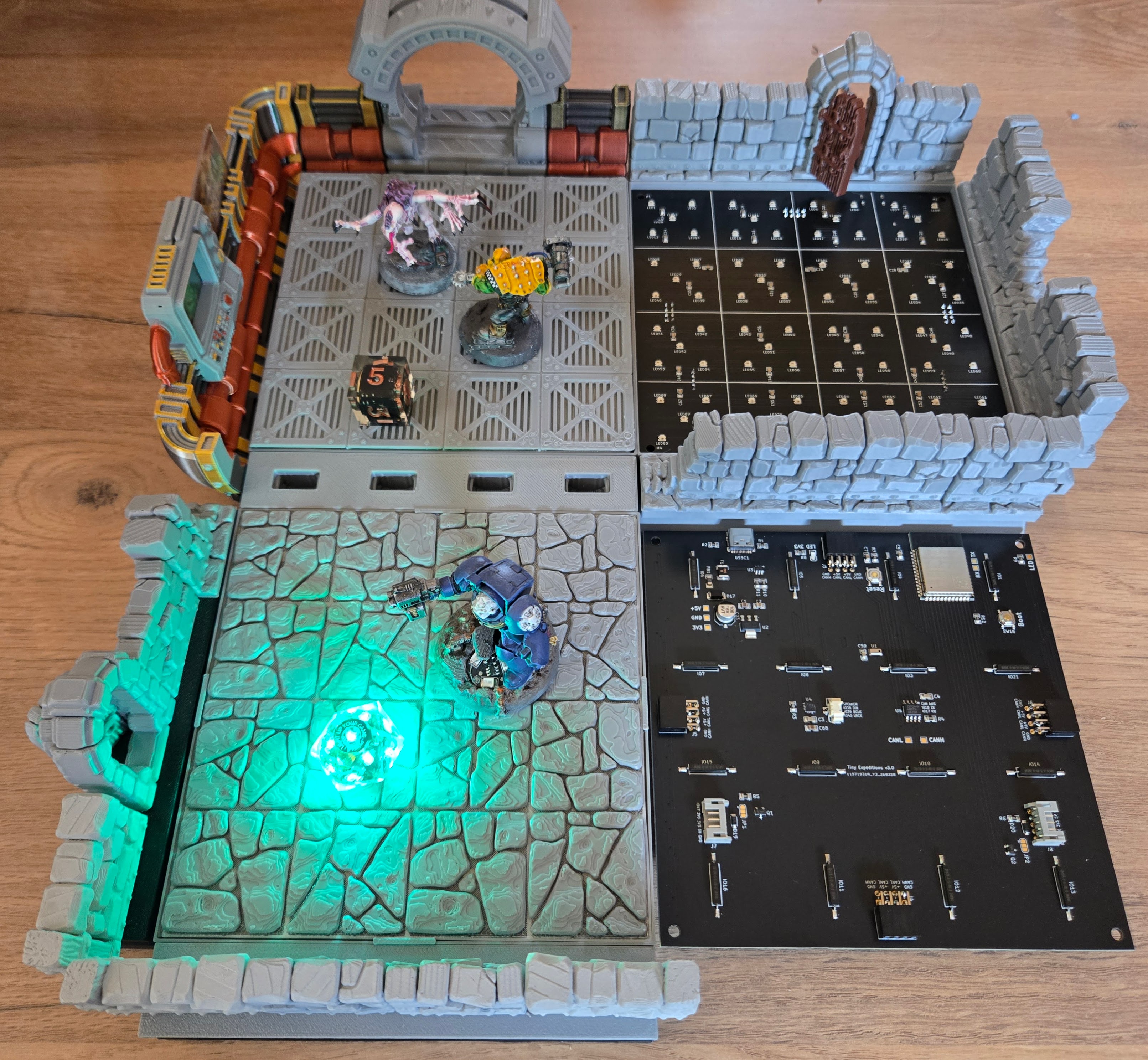
The PCB is a standard. Everything around it is open: the scenery on top, the hardware plugged into the side, the scenarios written in markdown. Three communities the platform exists to amplify - never replace.
Design, sell, and download new worlds. Community-certified 3D models and scenarios - the creator economy for tabletop.
The storytellers' stage. Find your next Game Master, broadcast your sessions, follow ongoing sagas. Think D&D meets Twitch.
Show off your heroes. World rankings, detailed stats, and progression tracking - your character sheet, public and persistent.
Track your collection, evaluate rarity, and trade on the secondary market. Every tile and card has a history.
Layer 2 - Sculptors
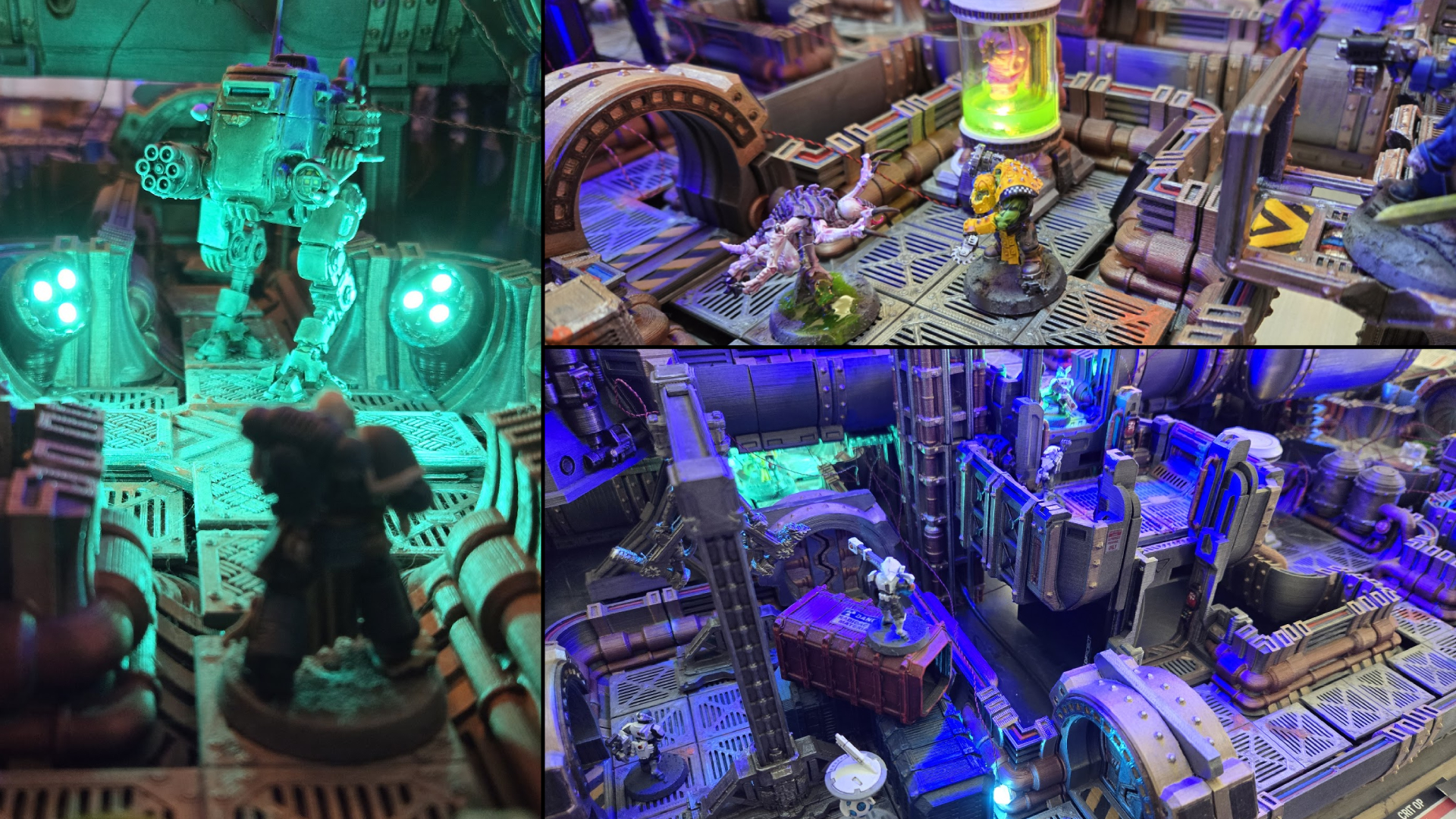
Your terrain is the universe. Build a fantasy dungeon, a sci-fi outpost, a gothic crypt — and give scenario authors a world to write inside. Players choose their adventure by choosing your world.
Open theming spec: wall pins, floor lip, door slots — your terrain snaps onto any Tiny Expeditions tile. Inspired by what modular dungeon creators like Dragon's Rest pioneered for the community.
Layer 3 - Makers
Two JST extension ports per tile expose power and GPIO. Your circuit talks to the scenario. The scenario talks back to your circuit.
The two JST ports per tile are a plugin interface. The demo shows the simplest case: a reed switch on a door + an LED strip, driven on/off by the scenario in real time. The same ports connect any inputs (GPIO sensor) or output (5V / 3.3V USB device).
The physical layer is fully yours: paint, resin, special inks, weathering — any finishing technique that works on PLA or resin prints. And because tiles connect via SmartLink, you can stack floors. A ground level connects to an upper level, each running its own scenario. The labyrinth goes vertical.
Connect with other creators, get early access to specs, and help shape the platform.
Start CreatingDocumentation, plugin examples, and scenario templates included.